June 24, 2026 • Petra Andersen • 11 min reading time • Prices verified June 25, 2026
Cabbing Machine Diagnostic: 6-Inch vs. 8-Inch Wheels, Water Systems, and What Used-Machine Buyers Must Check
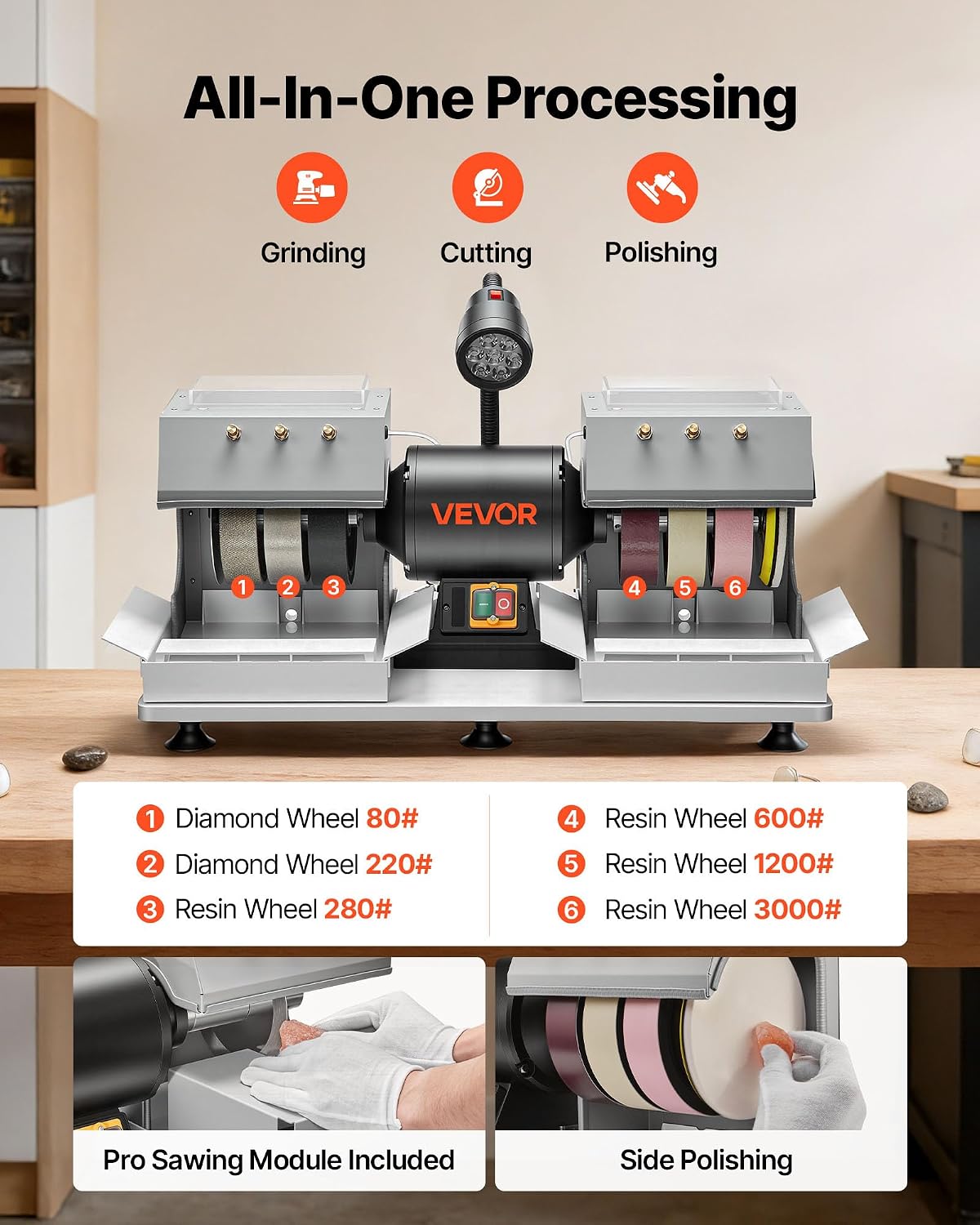
If you’ve ever wondered how a raw, rough-edged chunk of jasper or turquoise becomes the smooth, domed oval gemstone set in a ring or pendant, the answer is a cabbing machine — short for cabochon machine. A cabochon (cab-oh-SHON) is a gemstone shaped and polished into a smooth dome rather than faceted with flat angled cuts. Cabbing machines accomplish that work through a series of rotating grinding wheels — abrasive discs ranging from coarse grit for rough shaping down to ultra-fine pads for mirror polish — kept wet by a water delivery system to control heat and carry away slurry. If you’re shopping for your first serious machine or upgrading from a starter unit, the first fork in the road is this: 6-inch wheels or 8-inch wheels? That choice ripples through your budget, your workspace, the size of stone you can realistically work, and how the machine performs five years from now. This guide lays out the decision math plainly, covers water system differences that most buyers underestimate, and ends with the inspection checklist you need before handing over money on a used machine.
| EDITOR'S PICK[CabKing Cabbing Machine Lapidar…](https://www.amazon.com/dp/B01NAU8SIQ?tag=greenflower20-20) | Mid-tier[VEVOR Cabbing Machine](https://www.amazon.com/dp/B0GQ3CXJSF?tag=greenflower20-20) | Budget pickHi-Tech Diamond 6" Slant Cabber… | |
|---|---|---|---|
| Wheel Size | 8" | 6" | 6" |
| Motor Power | — | 2/5 HP | — |
| Speed (RPM) | — | 1800 | — |
| LED Lamp | ✓ | ✓ | — |
| Water System | ✓ | ✓ | — |
| Accessories | Complete | — | — |
| Price | $2,499.00 | $855.90 | $599.00 |
| See on Amazon → | See on Amazon → | See on Amazon → |
6-Inch vs. 8-Inch Wheels: What the Size Difference Actually Means
Wheel diameter is not just about physical scale — it changes the geometry of grinding in ways that matter for finished stone quality and operator fatigue. The three subsections below map to the three buyer tiers most likely to be evaluating this decision.
Budget and Entry-Level Buyers: The 6-Inch Case
A 6-inch wheel gives the outer edge a working surface of roughly 28 square inches. For small to medium cabs — under about 30mm — that is functionally sufficient for the vast majority of jewelry-scale work. The International Gem Society’s cabochon cutting introduction, published at gemsociety.org, notes that wheel width (the side-to-side depth of the wheel face, not diameter) is often the binding constraint for wide stones; 6-inch units typically ship with 1-inch-wide wheels, which handles standard oval and round cab sizes comfortably.
Weight is where 6-inch machines win cleanly for space-constrained buyers. Per published specification documents from Diamond Pacific Tool Corporation, the Pixie series — the benchmark 6-inch combination unit — weighs approximately 40–45 lbs depending on configuration, with a footprint of roughly 18–20 inches wide. For hobbyists working on a folding table or a shared bench in a gem club setting, that portability is a genuine advantage, not a minor footnote. Kingsley North’s current product listings at kingsleynorth.com show Pixie-series units in the $499–$549 range depending on wheel configuration, making the entry price accessible for hobbyists building out a first real setup.
The honest caveat: if your workflow regularly involves stones wider than 35mm, or you anticipate moving into larger freeforms, a 6-inch machine will feel limiting inside a year. Buying small to save money and then cycling through machines is the most expensive path in the long run.
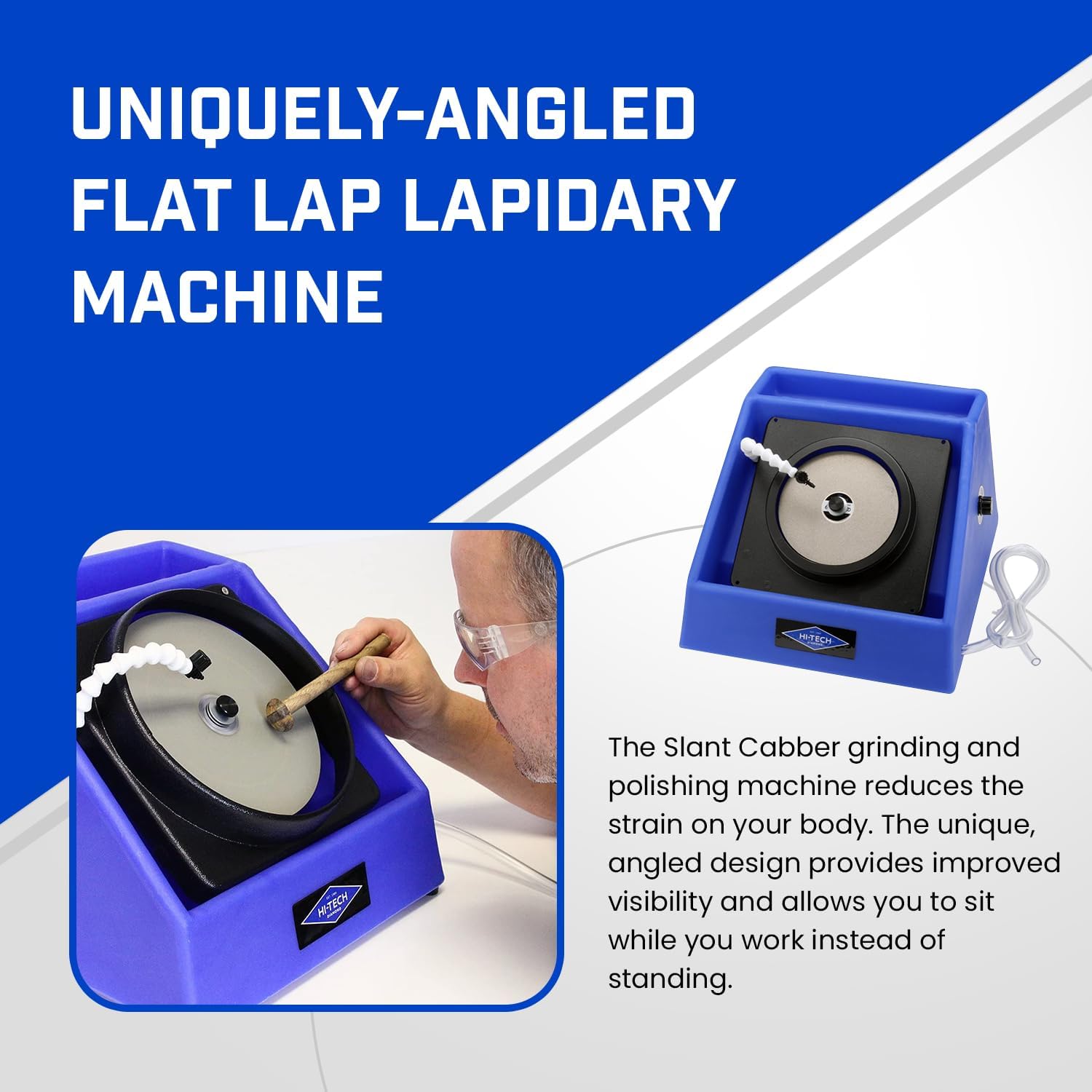
Hi-Tech
$599.00
In stock on Amazon
Check price on AmazonMid-Range Buyers: Balancing Capability and Cost
The mid-range decision space sits between an upper-end 6-inch unit and an entry-level 8-inch unit — roughly $600–$1,000 new. Buyers in this range are often gem club members who cut regularly but not at production volume, or intermediate lapidary artists expanding from hobby to semi-serious practice.
At this tier, surface speed becomes a meaningful consideration. A larger wheel turning at the same RPM covers more surface distance per revolution. On an 8-inch wheel, the outer edge moves significantly faster than the same point on a 6-inch wheel at identical motor speed. Higher surface speed generally means faster material removal and, counterintuitively, can mean less localized heat per unit of stone contact, because the abrasive contacts any given spot for a shorter moment per revolution. Lapidary Journal Jewelry Artist’s equipment coverage, published at lapidaryjournal.com, consistently documents that operators working harder materials — nephrite jade, Montana sapphire, tigereye — find 8-inch units run cooler and smoother under sustained grinding.
Hi-Tech Diamond’s published combination unit specification sheets show their mid-tier 8-inch units entering the market around $950–$1,100 with standard wheel sets. For buyers who can stretch the budget here, the working surface jump to approximately 50 square inches on an 8-inch wheel meaningfully expands the range of cab sizes that can be worked without repositioning or fighting the wheel edge.
VEVOR
$855.90
In stock on Amazon
Check price on AmazonProfessional and Studio Buyers: The 8-Inch Investment
For anyone running a small production studio, cutting display-scale pieces, or anticipating volume growth within two years, the 8-inch machine is the correct platform — and buying it once is cheaper than the upgrade cycle. The Diamond Pacific Genie, the 8-inch flagship per specification documents published by Diamond Pacific Tool Corporation, weighs 85–95 lbs and runs 24–26 inches wide. That footprint requires a dedicated, stable bench — not a shared worktable — but the payback in throughput and finished stone quality justifies the setup investment for serious use.
Kingsley North’s current listings (May 2026) show Genie-series units opening at approximately $1,150–$1,250. Used, a clean Genie typically prices at 55–65% of new retail in the current secondary market — a meaningful discount, but one that demands the inspection discipline covered in the final section of this guide.
Comparison summary: 6-inch vs. 8-inch at a glance
| Factor | 6-inch unit | 8-inch unit |
|---|---|---|
| Typical weight (combination unit) | 40–50 lbs | 85–100 lbs |
| Working surface (approx.) | ~28 sq in | ~50 sq in |
| Entry price range (new, 2026) | $400–$700 | $900–$1,600 |
| Ideal max cab width | ~30mm | ~50mm+ |
| Wheel width (typical) | 1 inch | 1.5 inches |
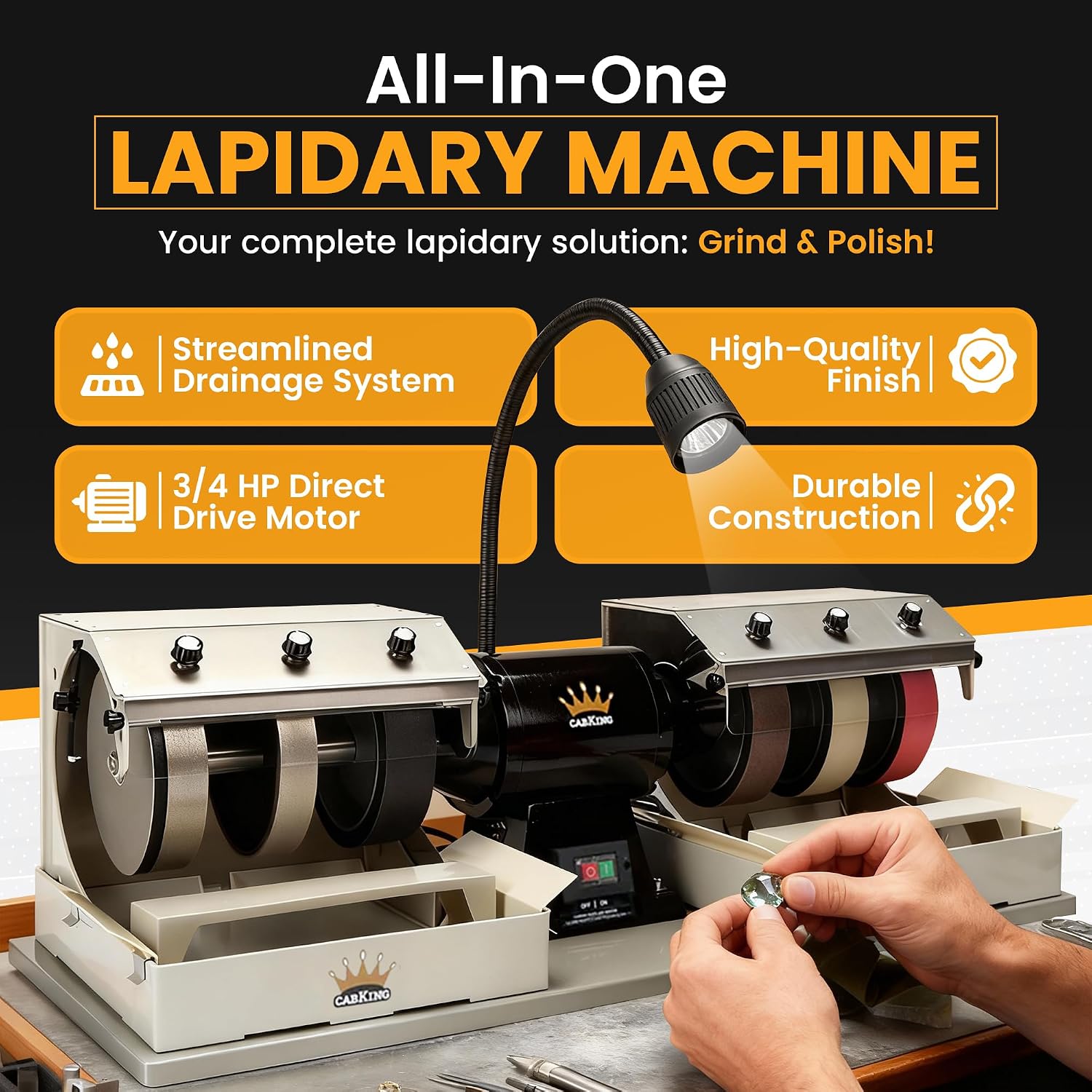
CabKing
$2,499.00
In stock on Amazon
Check price on AmazonWater Systems: The Detail Most Buyers Underestimate
Every cabbing machine uses water during grinding — without it, heat buildup cracks stones, destroys wheels, and creates silica dust hazards. Not all water delivery systems perform equally, and this is where many buyers make a consequential error of undervaluation.
Drip systems. The most common setup on mid-range machines routes water from a reservoir — typically 1–3 gallons — through a tube with a needle valve to a drip point above or behind the wheel. Proper drip-rate calibration is critical: too slow and you get heat cracking and glazed wheels; too fast and you flood the splash pan and waste coolant. Drip systems are mechanically simple, easy to service, and have almost no failure modes beyond clogged tubes or corroded valves. For most hobbyist-to-intermediate users, a well-maintained drip system is entirely adequate.
Recirculating pump systems. Higher-end and professional units — including several Diamond Pacific and Hi-Tech Diamond configurations per their published specification sheets — use a small pump to push water from a sump pan back up to the wheels continuously. Advantages include consistent flow without manual adjustment and lower overall water consumption per session. The tradeoff, as documented in Lapidary Journal Jewelry Artist’s tool maintenance coverage at lapidaryjournal.com, is that pump impellers clog with fine grinding slurry if the sump isn’t cleaned after every session. On a used machine, a slurry-gunked pump is among the most common hidden defects and one of the first things to test.
Splash containment and drain design. A poorly designed splash pan turns a grinding session into a wet-floor event and corrodes the machine’s base over time. Look for pans with raised lip edges of at least 2 inches, a smooth interior that drains fully (no standing-water corners), and either stainless steel or heavy ABS plastic construction. Stamped-steel shallow pans rust reliably within 12–18 months of regular use — a defect that starts cosmetically and progresses structurally.
Water quality note. Hard water — high in dissolved minerals, above roughly 150 ppm total dissolved solids — deposits calcium scale on wheels and in pump impellers over time. Using filtered or softened water in hard-water areas meaningfully extends wheel and pump life. This is a low-cost operational habit with compounding returns over a machine’s multi-year lifespan.
The Used-Machine Inspection Checklist
Used cabbing machines in good condition sell routinely at 40–65% of new retail. At that discount, buying used makes strong financial sense — if you know what to evaluate. The following checklist reflects the consensus of experienced lapidary buyers, gem club instructors, and the diagnostic guidance documented in Lapidary Journal Jewelry Artist’s equipment maintenance coverage at lapidaryjournal.com. Run every point before committing money.
1. Arbor runout. The arbor is the central shaft that grinding wheels mount onto. Runout is any wobble or off-center rotation in that shaft. Even minor runout — 0.005 inches or more — causes uneven wear on expensive diamond wheels and produces inconsistent surface quality on finished stones. Test by attaching a dial indicator to the machine body and touching the arbor shaft while rotating it by hand. Without a dial indicator, mount a wheel and observe its face edge-on at slow speed — any visible wobble disqualifies the machine. Arbor replacement is not a beginner repair; this defect is the single most disqualifying finding on a used machine.
2. Bearing noise and feel. Spin the arbor by hand with no wheels attached. Listen for roughness, grinding, or clicking; feel for resistance that isn’t smooth and consistent. New bearings in parts cost $15–$40, but pressing them in and realigning the arbor is significant labor if you’re not mechanically experienced — factor that into your offer price.
3. Wheel condition. Diamond wheels can be glazed (loaded with stone material, reducing cutting ability), chipped at the face edge, or unevenly worn across the face. A glazed wheel can often be dressed back to cutting condition with an inexpensive dressing stick. A chipped wheel is a replacement cost — budget $60–$180 per wheel depending on grit and size. Count and inspect every wheel included with the machine.
4. Motor condition. Ask the seller to run the machine for at least 10 minutes under light load, then feel the motor housing. Mild warmth is normal; hot-to-touch indicates a motor running at or near its rating ceiling, possibly from worn brushes on universal motors or a failing capacitor on induction motors. Confirm the motor’s nameplate amperage rating matches the machine’s listed specification — mismatched motors from prior field repairs appear on older machines more often than sellers acknowledge.
5. Water system completeness and function. Confirm the reservoir, all tubing, and any pump components are present. Run water through the system and watch for leaks at fittings, cracks in the reservoir, or a pump impeller that spins but moves no water (impeller erosion). Replacement pumps for common units run $25–$60, but sourcing the correct model for an older or off-brand machine can be time-consuming and occasionally impossible.
6. Splash pan integrity. Pull the pan and inspect its underside and drain fittings. Rust, stress cracks, or prior epoxy repairs around the drain indicate water has been sitting or escaping in ways that accelerate base-frame corrosion. Per Kingsley North’s current parts listings at kingsleynorth.com, a replacement pan for a Diamond Pacific unit runs $80–$120; for off-brand machines, replacement pans may not be available at any price.
7. Documentation. The original manual matters — not for nostalgia, but because wheel arbor thread specifications, safe RPM ratings per wheel diameter, and lubrication intervals are machine-specific. Mismatched wheels (wrong bore diameter or exceeding safe RPM for that arbor speed) are a safety issue, not merely a performance one.
Decision Rules: Matching Machine to Buyer
The International Gem Society’s cabochon cutting introduction at gemsociety.org frames the core principle cleanly: the machine is a long-term platform, not a consumable. Wheels, grit sequence, and operator technique are variables you tune over time — but you live with the arbor, the motor, and the water system for years. That framing yields three clean decision rules:
-
Under $700, jewelry-scale cabs, limited bench space: a quality 6-inch unit — new or used and verified — is the right machine. A used Diamond Pacific Pixie or Hi-Tech Diamond 6-inch combination unit in clean condition typically prices between $250–$400 in the current secondary market.
-
Larger stones, studio production, or meaningful volume growth expected within two years: buy the 8-inch now. The used-market premium for a clean Genie versus a clean Pixie is real, but so is the depreciation you avoid by not cycling through machines on the way there.
-
Any used machine under $500: run all seven inspection points before committing. The items most commonly skipped — arbor runout and pump condition — are the most expensive to remedy post-purchase. A machine that passes all seven at $350 is a genuine bargain. A machine that fails runout or motor tests at $200 is not a deal at any price.
Evaluate accordingly, and the machine you buy will still be cutting clean cabs a decade from now.