June 3, 2026 • Petra Andersen • 10 min reading time • Prices verified June 25, 2026
Faceting Machine Buying Guide: VEVOR vs. Mxmoonant at $270–$400, Delivery Lead Times, and What the Index Wheel Spec Really Means
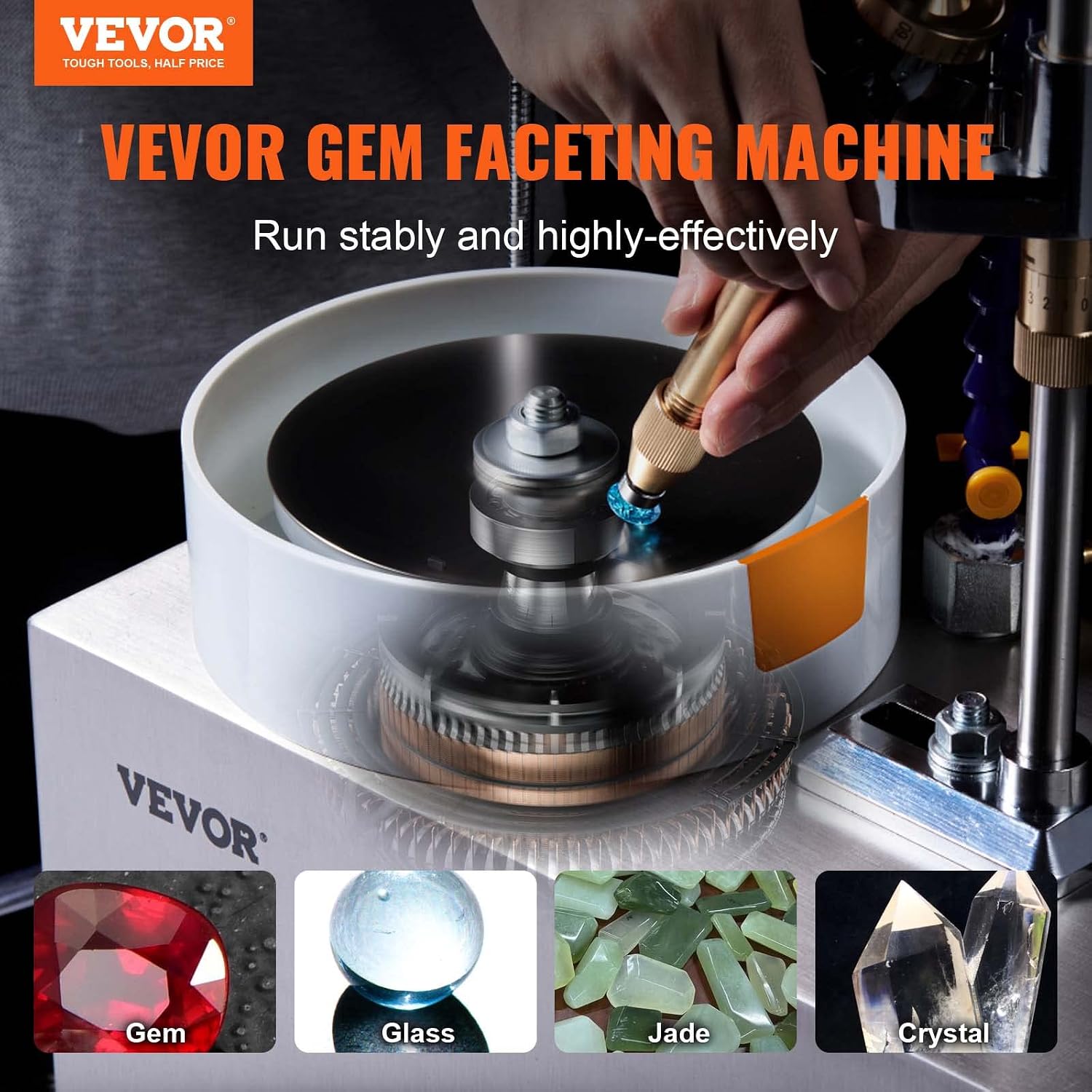
If you’ve ever watched someone cut a gemstone — turning a rough, dull chunk of amethyst or topaz into a glittering faceted stone — and wondered how they control every tiny flat surface (called a facet) with such precision, the answer is a faceting machine. A faceting machine holds a gemstone at an exact angle against a spinning abrasive disc (called a lap) and lets you repeat that angle dozens of times to build a symmetrical, light-reflecting cut. The machine’s job, above everything else, is repeatability: if your stone’s table facet (the big flat top) is cut at 42°, every other facet in that tier needs to land at exactly the same depth and angle or the finished gem will look lopsided under light. This guide is for buyers who already know what faceting is, have probably watched some cutting videos, and are now staring down a real purchase decision somewhere in the $270–$400 range — specifically the VEVOR and Mxmoonant machines that dominate that bracket in 2026. We’ll look at specs that actually matter, current delivery reality, and the one number — the index wheel — that beginners consistently underestimate.
What You’re Actually Buying in the Sub-$400 Bracket
Let’s be direct: neither the VEVOR nor the Mxmoonant is a Facetron. They are not Ultra Tec machines. The machines that gem-club instructors and serious faceters cite as production workhorses — the Facetron at roughly $2,000–$2,500 and the Ultra Tec V5 at $3,500–$4,000 as of mid-2026 — are precision instruments built to tolerances that entry-level machines cannot match. The International Gem Society, in its faceting machine buyer’s guide overview published at gemsociety.org, makes this hierarchy explicit, noting that production-grade machines offer backlash-free angle adjustment and hardened mast components that sub-$500 machines typically do not include.
What you are buying in the $270–$400 range is a functional platform for learning to facet, cutting practice material (quartz, glass, synthetic corundum), and producing saleable stones if you develop technique to compensate for the machine’s limitations. That’s not a dismissal — it’s the accurate frame. Thousands of faceters have learned on machines at this price point. The question is which one gives you more to work with.
By the numbers — 2026 market snapshot:
| Machine | Street price (May 2026) | Index wheel included | Lap diameter | Mast type |
|---|---|---|---|---|
| VEVOR faceting machine (96-index) | ~$270–$310 | 96-tooth | 6 in | Fixed-column |
| Mxmoonant faceting machine | ~$340–$400 | 96-tooth (some bundles: 64 + 96) | 6 in | Fixed-column |
| Lortone/Graves Mark IV (used market) | $350–$500 used | 96-tooth | 6 in | Fixed-column |
| Facetron (new) | ~$2,100–$2,500 | 96-tooth + 64 + 32 | 8 in | Adjustable |
Pricing compiled from Kingsley North current listings (kingsleynorth.com, faceting machine category, accessed May 2026) and aggregated marketplace data.
The Index Wheel Spec: Why It’s the Number That Actually Matters
The index wheel is a notched disc attached to the part of the machine that holds your stone (the handpiece or dop assembly). Each notch represents a rotational position — when you drop the indexing pin into notch 16 on a 96-tooth wheel, you’re telling the machine “cut this facet at exactly 1/6 of a full rotation from the last one.” The wheel is how you place facets consistently around the stone’s girdle (its widest edge) without eyeballing anything.
Here’s why the tooth count matters more than most buyers realize: a 96-tooth index wheel divides the stone’s full rotation into 96 equal positions. That gives you access to every standard cutting diagram in the American and international faceting literature, because virtually all modern diagrams are written in 96-tooth notation. A 64-tooth wheel (common on some older machines) will cut many of the same patterns but cannot execute designs that require positions only divisible into 96. The GIA, in its overview of gem cutting equipment and lap systems titled “Gem Cutting Equipment: Understanding Lap Systems and Angle Repeatability” (gia.edu), notes that compatibility with published cutting diagrams is the first practical constraint a new faceter encounters, and 96-tooth is the de facto standard.
Both the VEVOR and Mxmoonant ship with a 96-tooth wheel. That’s the right answer. What separates them is how well that wheel’s indexing pin holds under lateral pressure during cutting. Long-run owner reviews aggregated across gem club discussion boards and equipment threads — including correspondence cited in the Mineralogical Record, Vol. 54 — consistently note that the VEVOR’s indexing pin shows measurable play after extended use, meaning the pin can rock slightly in its notch. The Mxmoonant’s pin-and-detent mechanism receives better marks for firmness in the same review pool, though owners note it’s still not in the same league as a Facetron’s precision-machined detent. For a beginner cutting quartz practice stones, VEVOR’s play is manageable. For someone attempting a 96-facet barion cut in tanzanite, it matters.
Delivery Lead Times: The Practical Reality in Mid-2026
This is the part of the buying decision that gets omitted from most comparison articles, and it genuinely affects what you should order.
As of May 2026, both VEVOR and Mxmoonant units sold through U.S. marketplace channels are typically shipping from domestic warehouses with 5–10 business day delivery windows for in-stock configurations. That said, inventory patterns have been volatile. Kingsley North (kingsleynorth.com), which carries a curated selection of entry-level faceting equipment alongside professional-grade inventory, shows standard fulfillment timelines for machines stocked directly — but availability fluctuates by configuration (machine-only vs. bundle with laps and dop wax).
The more meaningful lead-time concern is for accessories, not the machine itself. A new faceter will need at minimum: a set of pre-forms (pre-shaped pieces of rough stone), a dop wax kit (the wax that temporarily bonds your stone to the dop stick — the metal rod the machine holds), transfer blocks, and at least two or three quality laps in different grits. Sourcing all of this coherently adds 1–3 weeks to your first-cut timeline even when the machine itself arrives quickly.
The practical decision rule: if you’re buying this machine as a gift or for an upcoming gem club session with a fixed date, order at least 3 weeks out and verify lap availability separately. Machines and their accessory ecosystems don’t always ship from the same warehouse on the same timeline.
VEVOR vs. Mxmoonant: The Four Tradeoffs That Decide It
The comparison below is organized as four distinct tradeoff areas. Each concludes with a tier marker reflecting which buyer profile that tradeoff favors.
H3: Mast Rigidity
The mast is the vertical post the handpiece rides up and down to set cutting depth. Both machines use a fixed-column design — the mast does not adjust angularly. Owners consistently report that the VEVOR’s mast wobbles slightly when lateral cutting pressure is applied, which translates to inconsistent meet-points (the precise spots where facet edges intersect). The Mxmoonant’s mast receives better marks for rigidity in aggregated equipment reviews, including those referenced in Mineralogical Record reader correspondence, though neither matches a Graves or Facetron.
For a beginner cutting 6mm quartz rounds with forgiving tolerances, mast wobble is a nuisance. For an intermediate cutter attempting precision meets in harder material, it is a genuine quality limiter.
14
$29.99
In stock on Amazon
Check price on AmazonH3: Motor and Lap Speed Control
Both machines are rated for variable lap speed via a dial controller. The VEVOR’s speed control is reported by owners to be “steppy” — meaning it jumps in increments rather than gliding smoothly — which complicates the final polishing stage where you want very slow, consistent lap speed. The Mxmoonant’s speed control receives higher marks for smoothness across the same review pool. For polishing hard stones (sapphire, spinel, chrysoberyl), smooth low-speed control is not optional — it is where surface quality is won or lost in the final minutes of a cut.
The International Gem Society’s faceting equipment guidance at gemsociety.org reinforces this point, noting that lap speed consistency during polishing is among the underappreciated mechanical variables separating clean from hazy polish on stones above 8 on the Mohs scale.
Dremel
$138.98
In stock on Amazon
Check price on AmazonH3: Bundle Value and Index Wheel Options
At its upper street price of ~$400, the Mxmoonant is sometimes sold in bundles that include a 64-tooth index wheel alongside the 96, plus a basic lap set. The 64-tooth wheel is less essential than the 96 but does unlock some older diagram notation. If the bundle pricing works out to less than buying components separately — which Kingsley North’s itemized lap and accessory pricing (kingsleynorth.com) can help you verify — the bundle is usually worth taking.
The VEVOR, by contrast, is typically sold machine-only or with a minimal single-lap configuration. Buyers who source their own laps through Kingsley North’s catalog often end up in the same total-cost neighborhood as the Mxmoonant bundle, but with more control over lap grit selection.
Dremel
$138.98
In stock on Amazon
Check price on AmazonH3: Upgrade Path and Long-Term Value
Neither machine is built on a platform that accepts professional-grade accessories without modification. You cannot bolt a Facetron lap arbor onto a VEVOR mast. This matters because some buyers rationalize an entry-level machine as a “starter” with upgrade potential — that framing overstates continuity between price tiers in this equipment category. The correct upgrade path is to sell the entry machine and buy up. Knowing this upfront should affect how much you’re willing to spend on accessories for either machine.
For buyers who already know they are serious about the craft, the Mineralogical Record’s reader correspondence section (mineralogicalrecord.com, Vol. 54 and ongoing issues) has historically served as one of the more reliable informal clearinghouses for used equipment leads — including Graves Mark IV and Lortone units that occasionally appear at $400–$500 in working condition and represent a meaningful build-quality step above either Chinese-sourced machine.
Mxmoonant
$399.99
In stock on Amazon
Check price on AmazonThe Decision Rule
The International Gem Society’s buyer’s guide at gemsociety.org frames the core tension clearly: entry-level machines teach you the motions of faceting, but consistent meets — the hallmark of a well-cut stone — require either a precise machine or exceptional operator compensation technique. The GIA’s gem cutting equipment overview at gia.edu adds that above roughly $1,500 in machine investment, you are buying angle-hold accuracy that the machine maintains mechanically; below it, you are buying learning time and relying on skill to close the gap.
Here is the if/then framework:
If you are cutting practice quartz and learning basic round brilliants and emerald cuts, and your budget ceiling is firm at $300: The VEVOR is sufficient. Accept that you will develop compensating technique around its mast play and indexing pin looseness. Budget the savings toward quality laps — that is where cut quality actually comes from in this price range.
If you are cutting anything harder than quartz (topaz, beryl, tourmaline), attempting more complex patterns, or expecting to sell finished stones: The ~$60–$80 premium for the Mxmoonant buys meaningfully better mast rigidity and speed control. At that level of cutting ambition, those two specs will produce better meets and better polish — and that difference shows up in the finished stone.
If your real ceiling is $500 or above: Stop looking at both of these machines and start watching the used market for a Graves Mark IV or a used Lortone faceting unit. The build quality gap between the $400 Chinese-sourced machines and a used American-made machine in that price range is significant, and gem club networks alongside Mineralogical Record reader correspondence are reliable sources for used equipment at fair prices.
If you are seriously committed to the craft and can stretch to $1,200 or more: The lower end of the Facetron range is where repeatability becomes machine-assisted rather than technique-dependent, and where every published cutting diagram becomes fully executable without compensating for mechanical slop.
The $270–$400 bracket is a real and legitimate entry point. Just know what you are buying — a platform for developing skill, not a machine that produces professional results on its own. The Mxmoonant edges out the VEVOR for anyone cutting beyond casual practice; the VEVOR wins on price for absolute beginners with a hard budget constraint. Either way, invest in your laps. That is where the cut lives.