June 7, 2026 • Petra Andersen • 10 min reading time • Prices verified June 25, 2026
Hi-Tech Diamond's Full Cabbing Lineup Decoded: Slant Cabber vs. All-U-Need, 6" vs. 8", and Which Fits Your Bench
If you’re new here: a cabbing machine (short for cabochon machine) is the workhorse tool lapidary hobbyists use to grind and polish rough rock into smooth, domed gemstones called cabochons — the flat-bottomed, rounded-top stones you see set in rings and pendants. The machine spins a series of abrasive wheels, and you move the stone through progressively finer grits until you get a mirror polish. Hi-Tech Diamond, a U.S.-based lapidary equipment company, makes a range of these machines at price points that sit between hobby-grade entry machines and full professional cabbing units. If you’ve outgrown a starter tumbler and you’re ready to shape stones on purpose rather than just smooth them by accident, Hi-Tech Diamond is one of the first brands you’ll seriously consider. This article breaks down every major configuration they offer — wheel diameter, motor size, unit style — so you can match the machine to your actual bench situation, not just the one with the best photo.
What Hi-Tech Diamond Actually Makes (and How the Names Can Confuse You)
Hi-Tech Diamond’s lineup clusters around two machine styles and two wheel sizes, and understanding that grid is the fastest way to stop feeling lost in their catalog.
The two styles:
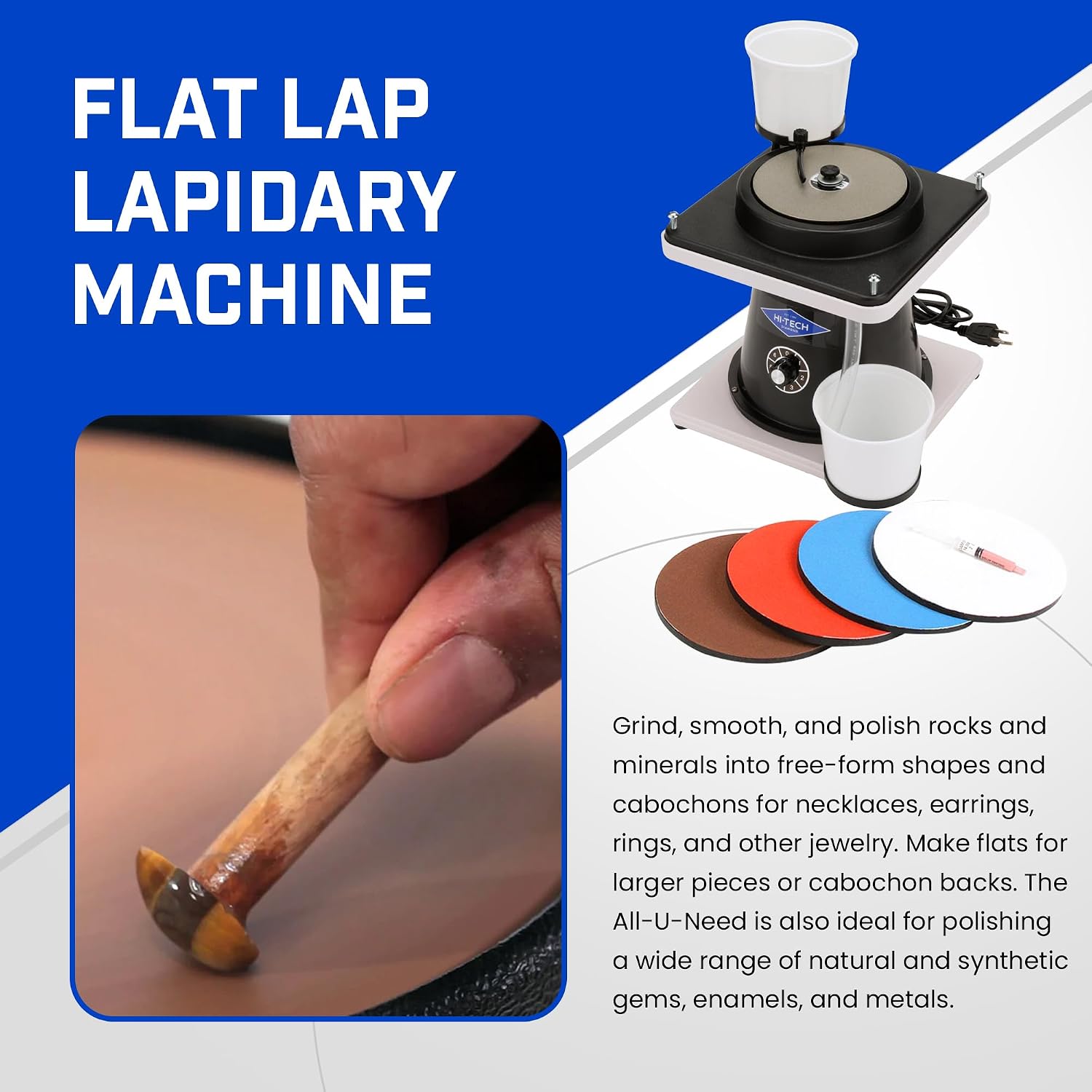
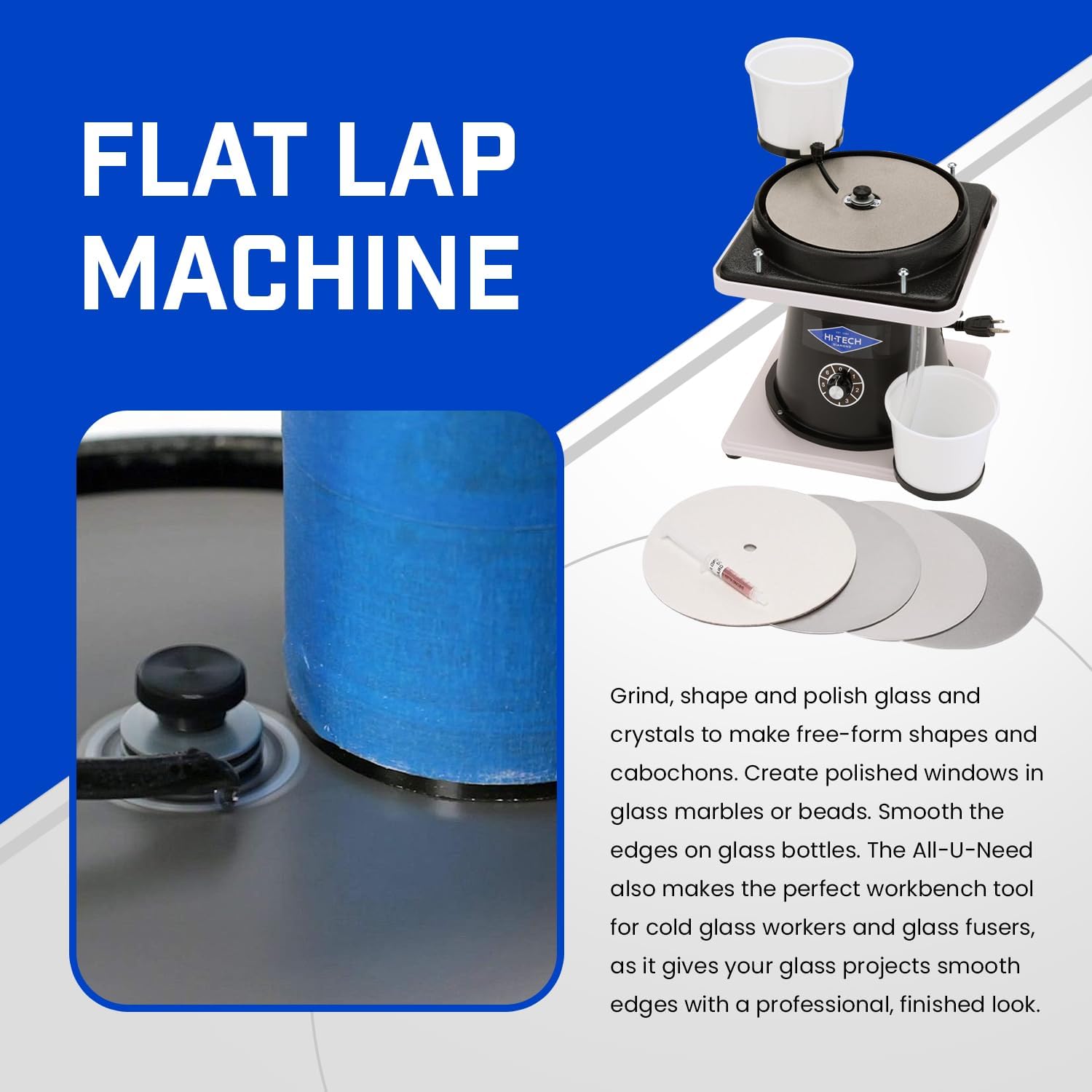
- All-U-Need — A single, self-contained unit that stacks multiple diamond-coated wheels and a polish pad on one horizontal arbor (a rotating shaft). You move the stone from wheel to wheel across the top of the machine. It’s the more compact, integrated design.
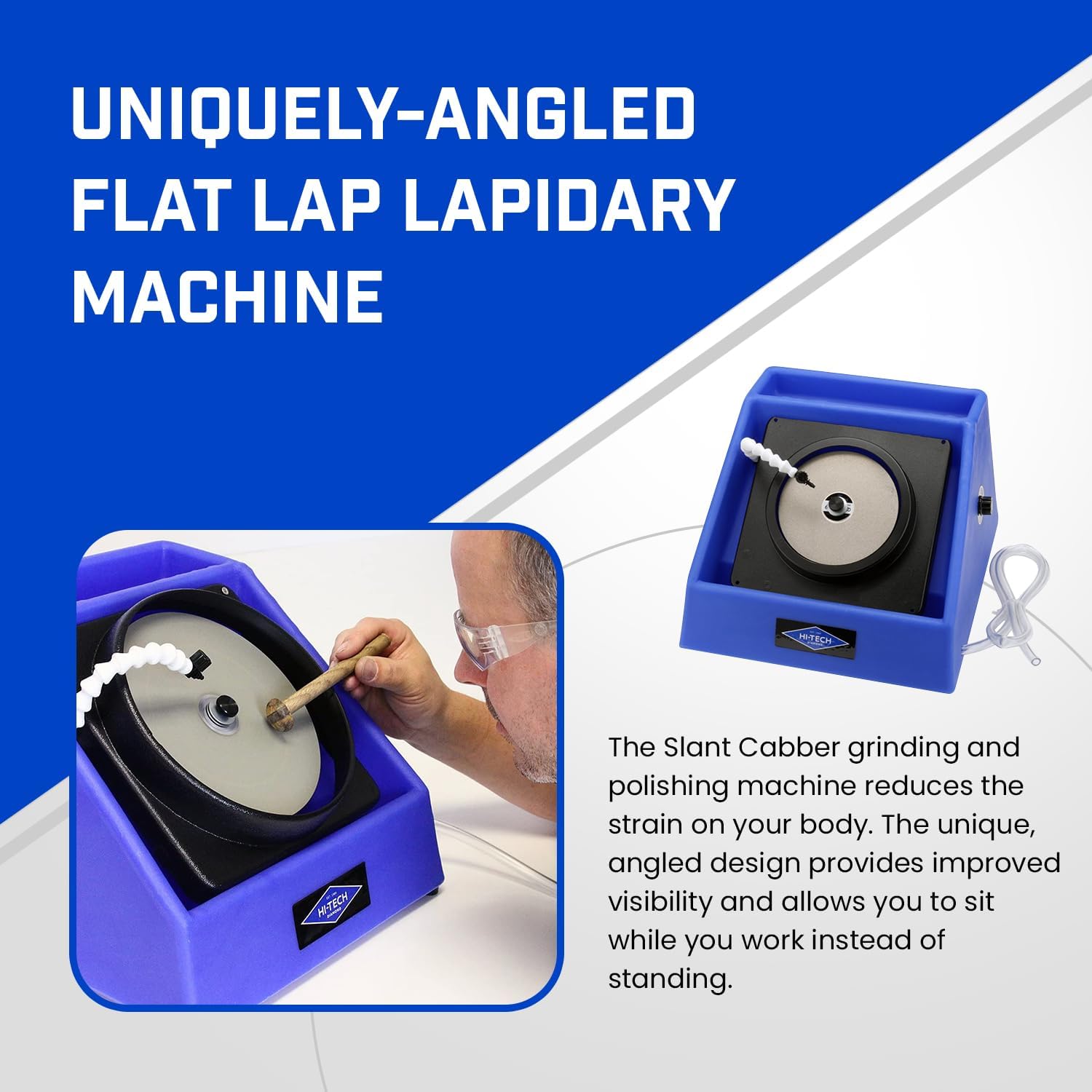
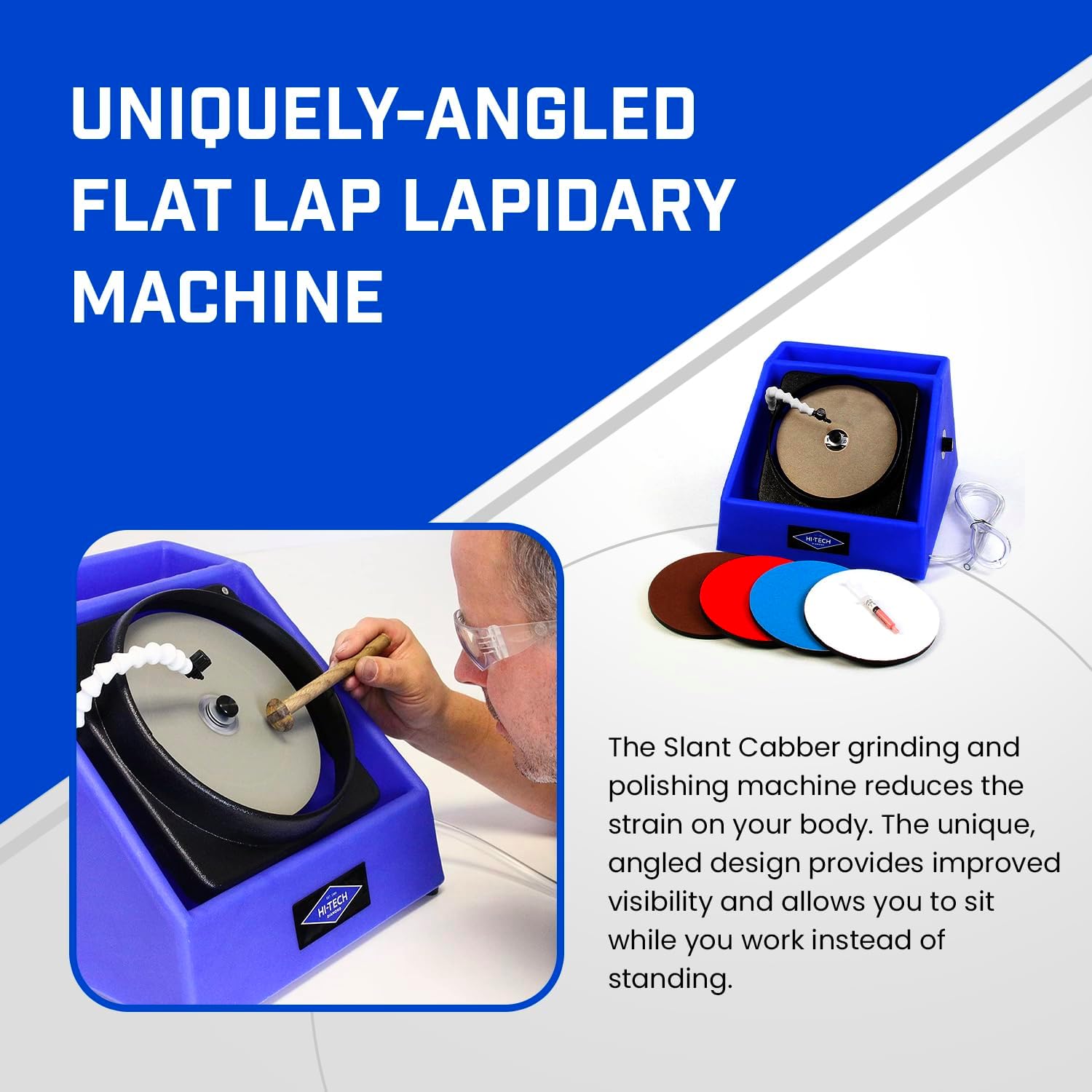
- Slant Cabber — A unit where the wheel surface faces you at an angle rather than horizontally. Owners report the slant geometry makes it easier to see your stone’s profile as you work, which matters when you’re trying to hit a specific dome height or maintain a consistent girdle (the edge that runs around the widest part of the cabochon).
The two wheel sizes:
- 6-inch wheels — Smaller diameter, lighter machine, lower price. The trade-off is that smaller wheels dish (wear a concave depression) faster under hard stones, and the shorter wheel face gives you less room to maneuver larger rough.
- 8-inch wheels — The step-up size. More surface area means slower wear, more working room, and a machine that handles production volume or larger slabs more comfortably.
Layered on top of that are motor specifications — typically ranging from 1/5 HP to 1/3 HP across the line — and the number of wheels included. Hi-Tech Diamond’s published product specifications list most units in the 1,725 RPM range for wheel speed, which is a moderate, controllable pace: fast enough to remove material efficiently, slow enough that you’re not burning soft stones.
The Comparison That Actually Matters: By the Numbers
| Machine | Wheel Size | Typical Wheel Count | Motor | Approx. Price Range (May 2026) |
|---|---|---|---|---|
| All-U-Need 6” | 6 in | 6 wheels + polish | 1/5 HP | ~$350–$420 |
| All-U-Need 8” | 8 in | 6 wheels + polish | 1/3 HP | ~$500–$580 |
| Slant Cabber 6” | 6 in | 6 wheels + polish | 1/5 HP | ~$380–$450 |
| Slant Cabber 8” | 8 in | 6 wheels + polish | 1/3 HP | ~$520–$610 |
Prices sourced from Kingsley North product listings (kingsleynorth.com), May 2026. Configurations vary; verify at point of purchase.
The price delta between 6” and 8” runs roughly $130–$160. The delta between All-U-Need and Slant Cabber at the same wheel size runs roughly $25–$40 — which means the style choice is mostly about ergonomics and workflow, not budget.
Style Choice: All-U-Need vs. Slant Cabber
This is the question Hi-Tech Diamond buyers debate most in gem club circles, and the honest answer is that both machines use the same wheel chemistry and motor class — the difference is purely in how you interact with the stone.
H3: All-U-Need — Familiar Flat Geometry
All-U-Need geometry puts the wheels flat and horizontal, like a series of grinding discs arrayed across a table. You look down at the wheel surface. This works naturally for people who learned to cab on a standard flat unit, and the machine takes up a slightly smaller vertical footprint on your bench.
The International Gem Society, in their cabochon cutting guidance published at gemsociety.org, notes that maintaining consistent downward pressure is generally more intuitive when the cutter’s hands are working over a horizontal surface — a principle the All-U-Need layout directly leverages. For beginners and cutters returning from a long break, that muscle-memory advantage is real.
The All-U-Need 6” is the most accessible entry point in Hi-Tech Diamond’s lineup and earns its place as the logical starting machine for casual hobbyists.
Hi-Tech
$599.00
In stock on Amazon
Check price on AmazonH3: Slant Cabber — Visibility as a Working Advantage
Slant Cabber geometry tilts the wheel face toward you at roughly a 45-degree angle. You push the stone into a surface you can see face-on rather than top-down. Equipment coverage in Lapidary Journal Jewelry Artist has consistently flagged two practical advantages owners report after extended use: first, the stone’s profile is visible in real time without repositioning your head; second, water — the coolant that keeps the wheels and stone from overheating — tends to clear the work surface more cleanly on a slant, reducing the mist that sometimes hits your face on a flat machine.
The noted disadvantage: the slant orientation means gravity is working against your stone’s contact with the wheel. Pressure must be more deliberate and consistent. For cutters who’ve already developed stone-control instincts — typically somewhere between six months and two years in — the sight-line advantage becomes the non-negotiable preference.
The Slant Cabber 6” sits at a modest premium over the All-U-Need 6” and is well-suited to intermediate cutters who are comfortable with pressure management and want better profile visibility on freeform or translucent material.
Hi-Tech
$699.00
In stock on Amazon
Check price on AmazonH3: Slant Cabber 8” — The Production and Precision Ceiling
For cutters running three or more sessions per week, working stones 30mm or larger, or cutting hard silicates (quartz, jasper, petrified wood — all in the 6.5–7 Mohs range), the Slant Cabber 8” represents the top of Hi-Tech Diamond’s standard consumer lineup. The 8-inch wheel surface reduces dishing, provides more room to maneuver large rough, and handles production-style volume without the premature wheel wear that limits the 6-inch format at high use rates.
Kingsley North’s buyer guidance for lapidary equipment, published at kingsleynorth.com, identifies the 8-inch wheel format as the practical minimum for anyone doing consistent production work at studio hobby scale — a threshold the Slant Cabber 8” meets fully. Owners who’ve cut 50 or more stones on slant geometry consistently report they wouldn’t return to flat geometry for profiling work.
Hi-Tech
$699.00
In stock on Amazon
Check price on Amazon6” vs. 8”: When Size Actually Changes the Outcome
The wheel size question is where the math becomes concrete, and it hinges on a single mechanical phenomenon: wheel dishing.
Dishing is the gradual concave wear that forms in the center of a grinding wheel when you concentrate contact in the same zone repeatedly. On a 6-inch wheel, that worn area represents a larger proportion of the wheel’s total radius, so distortion shows up in finished stones faster — typically as a slight hollow in the cab’s base or an uneven dome that doesn’t track cleanly. Hi-Tech Diamond’s published product specifications do not state a precise wheel-life figure in hours, but Kingsley North’s buyer documentation and equipment guidance at kingsleynorth.com consistently identifies 8-inch wheels as lasting meaningfully longer before significant dishing becomes a problem, particularly under hard stones.
Lapidary Journal Jewelry Artist equipment comparison features have noted the volume threshold repeatedly: the 8-inch format is effectively the minimum for anyone doing production-style work, even at studio hobby scale. If you’re cutting more than two or three stones per session, or running stones that are 40mm × 30mm or larger, the 8-inch machine gives you enough wheel face to work the stone without constantly tracking the same groove.
The case for 6-inch: It’s not purely a budget compromise. If your bench space is genuinely tight — under 24 inches of dedicated width — the 6-inch machines are meaningfully more manageable. They’re lighter, which matters if you transport a machine to a gem club, a class, or a show. And if you’re primarily cutting small stones under 25mm in their longest dimension, in softer minerals, the wheel-wear differential is much less pronounced in practice.
Decision rule: If you’re cutting stones 30mm or larger, cutting hard silicates regularly, or planning to run more than three sessions a week, the 8-inch wheel is the right call. The price difference — roughly $130–$160 — is recovered in wheel longevity within the first year of active use at that volume. If you’re space-limited, working small, or need portability, the 6-inch machines are not a step down in build quality — just in scale.
The Grit Sequence: What Comes in the Box
Every Hi-Tech Diamond machine ships with a standard progression of diamond-coated resin wheels. The typical sequence — confirmed in Hi-Tech Diamond’s published product descriptions at hi-techdiamondtools.com — runs: 80 grit (coarse shaping), 220 grit (fine shaping), 280 or 325 grit (smoothing), 600 grit (pre-polish), 1,200 or 3,000 grit (polish prep), and a leather or felt buff wheel for final polish with a compound such as cerium oxide or aluminum oxide powder.
This matters because the grit sequence is where Hi-Tech Diamond earns its reputation for approachability. Machines in this price class from some competitors require the buyer to source and mount their own wheel sets separately — a meaningful additional cost and a configuration learning curve. Hi-Tech Diamond ships everything needed to run a complete sequence out of the box, which is part of why Kingsley North features their machines prominently in starter and intermediate buyer guides on their site.
One important caveat the International Gem Society flags in their cabochon cutting guidance at gemsociety.org: diamond wheel sequences from different manufacturers are not always interchangeable in backing diameter, arbor fit, or grit-layer thickness. If you plan to upgrade individual wheels later, confirm fit compatibility before purchasing replacement wheels from a third-party source — a step that’s easy to overlook and expensive to get wrong.
Putting It Together: The Decision Framework
Here’s the plain-language version of everything above.
If you’re cutting casually (1–3 sessions per week, stones under 30mm, medium-hardness minerals): The All-U-Need 6” is the most efficient entry point. It handles a casual workflow without wheel-wear anxiety, fits a modest bench, and costs the least to get started. Treat the $130 you save over an 8-inch machine as your grit replenishment budget for the first year.
Hi-Tech
$599.00
In stock on Amazon
Check price on AmazonIf you’re cutting seriously (3+ sessions per week, large or hard stones, or producing work for sale): The All-U-Need 8” or Slant Cabber 8” is the correct answer. At this volume the 8-inch wheel pays for the price gap in durability. Choose All-U-Need 8” if you prefer familiar flat geometry; choose Slant Cabber 8” if you want maximum sight-line visibility on your stone’s profile.
Hi-Tech
$699.00
In stock on Amazon
Check price on AmazonIf you’re on the fence about style but know you want 8 inches: Spend the extra $25–$40 for the Slant Cabber 8”. Owners who’ve run both styles consistently report the profile visibility becomes a non-negotiable preference after 50 or more stones on slant geometry. It’s a small premium to avoid buyer’s remorse at the style level.
Hi-Tech
$699.00
In stock on Amazon
Check price on AmazonIf you’re evaluating Hi-Tech Diamond against Graves, Diamond Pacific, or Genie units in the same budget window: That’s a separate comparison, but the short version is that Hi-Tech Diamond’s value proposition is integration — everything included, immediate out-of-box workflow — versus some competitors’ modular approach, where you buy the machine and then source wheels separately. For intermediate buyers who want to spend time cutting rather than configuring, that integration consistently earns Hi-Tech Diamond its position in this price bracket.
Whatever your decision, Hi-Tech Diamond’s lineup represents a mature, well-documented set of machines with an active user community and reliable parts availability through U.S. dealers including Kingsley North (kingsleynorth.com) — which, for a machine you’ll run weekly, matters as much as the specs on the box.