May 26, 2026 • Petra Andersen • 8 min reading time • Prices verified June 25, 2026
Choosing the Right Diamond Blade for Your Lapidary Saw: Thickness, Arbor Size, and Stone Type Matched
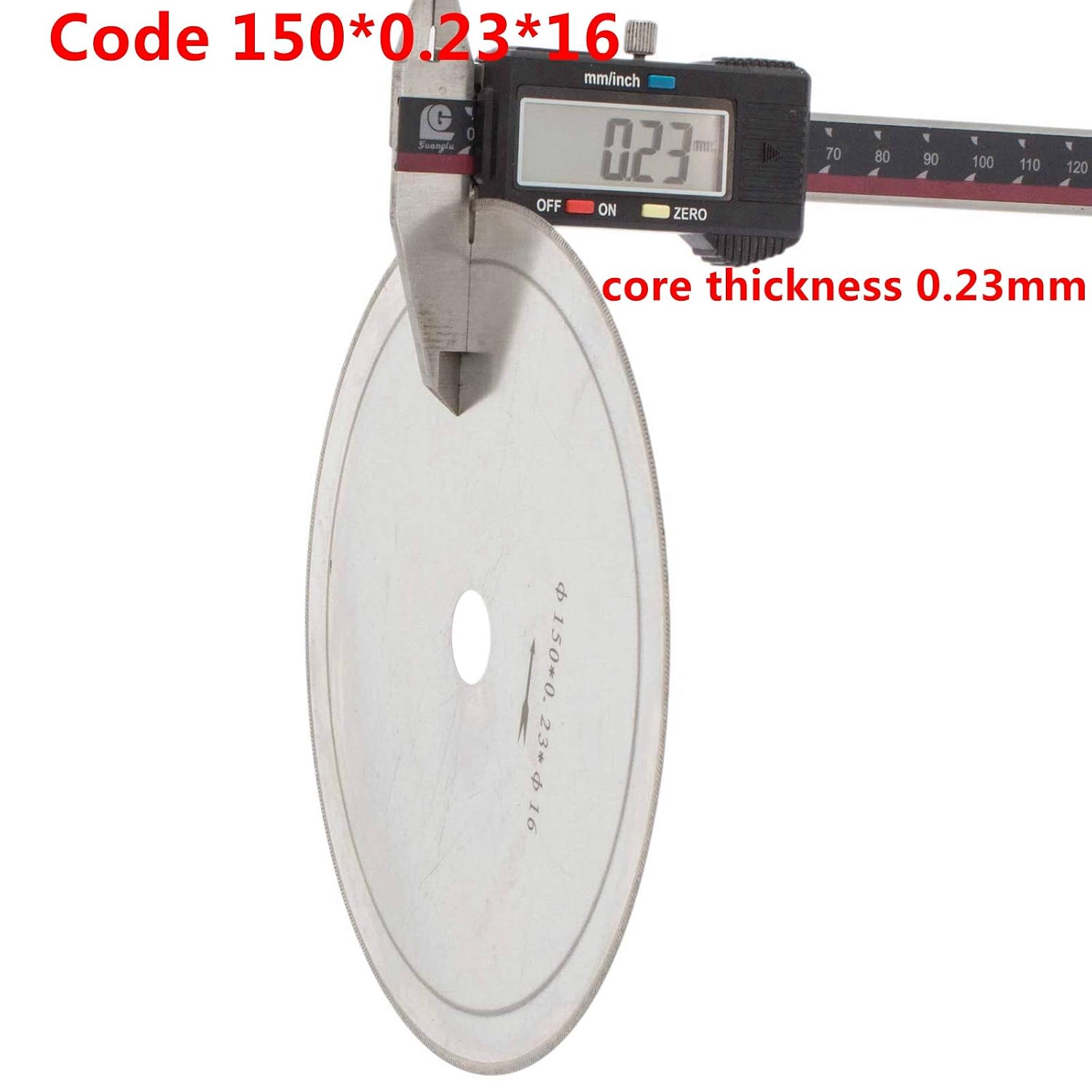
If you’ve ever looked at a pile of raw rock — rough stone that hasn’t been shaped yet — and wondered how lapidary artists (people who cut, grind, and polish stones) slice through it so cleanly, the answer is almost always a diamond blade. A diamond blade for a rock saw isn’t like a circular saw blade for wood; it’s a thin steel disc with industrial diamonds bonded into the rim, and it cuts stone by grinding through it rather than slicing. Picking the right one sounds simple until you’re standing in front of a spec sheet comparing “sintered” versus “notched” and trying to figure out whether your saw’s arbor — the central shaft the blade mounts on — takes a 1/2-inch or 5/8-inch hole. Get the match right and a blade lasts through hundreds of cuts. Get it wrong and you’re chipping expensive rough, warping the blade on the first hard jasper, or — worst case — stalling a motor that wasn’t built for the load.
This guide walks through the three variables that actually drive blade selection: blade thickness (kerf), arbor size, and stone hardness. It’s written for hobbyists who already own or are actively shopping a saw in the $150–$600 range and want to stop guessing at the blade bin.
| EDITOR'S PICKJINGLING 10" inch Diamond Lapid… | Mid-tier[JINGLING 6 inch Diamond Lapidar…](https://www.amazon.com/dp/B07V7BF4WG?tag=greenflower20-20) | Budget pick[JINGLING 7 inch Lapidary Blades…](https://www.amazon.com/dp/B071W4DK4R?tag=greenflower20-20) | |
|---|---|---|---|
| Diameter | 10" | 6" | 7" |
| Kerf thickness | 1.2mm | 0.4mm | — |
| Core thickness | — | 0.3mm | — |
| Rim type | Notched | Super-Thin | Thin |
| Quantity | 1 | 5 | 1 |
| Price | $26.99 | $19.99 | $15.99 |
| See on Amazon → | See on Amazon → | See on Amazon → |
Why Blade Thickness (Kerf) Is Your First Decision
Kerf is the width of material the blade removes as it cuts. On a lapidary saw, a thinner kerf means less stone lost to dust, cooler running temperatures, and less stress on the motor — but also a blade that flexes more under side pressure and wears out faster if you force the feed. A thicker blade runs stiffer, handles abrasive material more reliably, and tolerates an impatient hand on the rock, but it wastes more rough and demands more motor torque.
The practical breakdown by saw class:
-
Trim saws (6–8 inch blades, ~$150–$400 range): Most hobbyist trim saws — the Graves Mark IV, Lortone units in the entry-intermediate tier, and comparable machines — are engineered around blades in the 0.012–0.025 inch kerf range. The Graves technical documentation specifies the Mark IV for blades up to 8 inches; owners and club instructors consistently recommend staying at 0.018–0.025 inch for general lapidary work on this class of saw. Going thinner than 0.012 inch on a trim saw risks blade flutter, especially when cutting anything over 2 inches wide.
-
Slab saws (10–24 inch blades, $400–$1,500+ range): These are the large machines used to slice raw boulders into flat slabs. They take thicker blades — commonly 0.060–0.090 inch — because they’re cutting through 6–12 inches of material in a single pass. Motor horsepower scales accordingly, and the blade has to match that power delivery without bowing.
-
Faceting / cabbing trim work (4–6 inch blades): For slicing small parcels of fine rough — tourmaline, sapphire corundum, high-value material — the International Gem Society’s lapidary equipment overview flags ultra-thin blades in the 0.006–0.012 inch range as standard for minimizing kerf loss. At $15–$40 per gram for quality tourmaline rough as of mid-2026 pricing tracked in dealer listings, every millimeter of lost material is real money.
The math that changes your decision:
A 0.025-inch blade versus a 0.012-inch blade wastes roughly twice the material per cut. On a 4-inch tourmaline crystal worth $200, that difference across 10 slices is approximately 0.5 cm³ of lost rough — potentially $40–$80 in wasted value at current market rates.
This is why gem cutters working fine material almost always use the thinnest blade their saw can safely run, while slab cutters prioritize blade longevity and stiffness.
Arbor Size: The Fit That Can’t Be Fudged
The arbor is the shaft at the center of your saw’s motor that the blade bolts onto. The blade’s center hole — called the arbor hole or bore — must match that shaft diameter precisely. Unlike most saw accessories, you cannot approximate this fit with a bushing in most lapidary applications; a loose blade wobbles, cuts crooked, and can crack under load.
Common arbor sizes in the hobby lapidary market:
| Saw Class | Typical Arbor Diameter |
|---|---|
| 6-inch trim saws (entry-tier) | 1/2 inch |
| 8-inch trim/combination saws | 5/8 inch |
| 10–14 inch slab saws | 3/4 inch or 1 inch |
| 18–24 inch large slab saws | 1 inch or 1-1/4 inch |
Kingsley North’s blade listings — one of the most-referenced sourcing catalogs in the hobby — organize blades by arbor hole size and explicitly note that their trim saw blades ship in 1/2-inch and 5/8-inch bore variants. The spec is printed on the blade’s core and always listed in the product description. If you’re buying a replacement blade and don’t have the original packaging, measure the existing arbor shaft with a caliper before ordering; guessing costs you return shipping.
One complication worth knowing: some older saws — particularly used equipment picked up at gem club sales or estate auctions — were manufactured with non-standard arbor sizes, and replacement blades may need to be special-ordered. If you’re evaluating used equipment, confirm the arbor diameter before purchase.
Matching Blade Bond Type to Stone Hardness
Diamond blades aren’t all built the same way. The diamonds are embedded in a metal “bond” — the matrix that holds them against the steel core — and the hardness of that bond determines how the blade performs on different materials.
The core distinction: sintered vs. electroplated
Sintered blades (also called metal-bond blades) press the diamond-and-metal powder together under heat and pressure, producing a matrix that wears away gradually to expose fresh diamonds as you cut. These are the workhorses of lapidary; they last longer, handle abrasive and hard material well, and are the default recommendation in Lapidary Journal Jewelry Artist coverage for general shop use. Most blades in the $30–$120 range at lapidary suppliers are sintered.
Electroplated blades coat a single layer of diamonds onto the steel core using an electrochemical process. They cut aggressively at first, are often thinner, and cost less upfront — but once that single diamond layer wears through, the blade is done. They’re appropriate for occasional use on soft to medium-hard material (calcite, selenite, softer agates in the Mohs 6–7 range) but wear out quickly on hard jasper, chert, or corundum.
Soft bond vs. hard bond in sintered blades:
Within sintered blades, the bond hardness is its own variable:
- Soft bond: Wears faster, continuously exposing fresh diamond — ideal for hard, dense stone like sapphire corundum (Mohs 9), spinel, or hard jasper. The bond sacrifices itself to keep cutting.
- Hard bond: Holds diamonds longer — appropriate for softer, more abrasive stone like sandstone, some agates, or turquoise matrix. Softer stone wears the bond before the diamonds exhaust, so you need the bond to last.
This is counterintuitive and catches intermediate buyers. The International Gem Society’s lapidary equipment section flags this specifically: cutting hard stone requires a softer bond so the blade self-dresses (exposes new diamonds continuously). Using a hard-bond blade on corundum produces glazing — the bond surface polishes smooth without exposing fresh diamonds, and the blade stops cutting efficiently.
Quick reference by stone type:
| Material | Mohs Range | Recommended Bond |
|---|---|---|
| Calcite, selenite, soft mineral specimens | 3–4 | Electroplated or hard-bond sintered |
| Agate, jasper, chalcedony | 6.5–7 | Standard sintered, medium bond |
| Quartz crystal, amethyst rough | 7 | Standard sintered, medium bond |
| Tourmaline, beryl | 7–8 | Sintered, medium-to-soft bond |
| Sapphire, corundum, spinel | 9 | Sintered, soft bond |
Blade Diameter and the Depth-of-Cut Constraint
One detail that’s easy to overlook: the blade diameter determines your maximum depth of cut, which is approximately 1/3 of the blade diameter (accounting for the blade housing, arbor flange, and coolant level in the saw tank).
An 8-inch blade gives you roughly 2.5–2.75 inches of usable cut depth. A 10-inch blade gets you to about 3.25 inches. This matters when you’re planning how to orient a large piece of rough — a 4-inch-wide agate nodule isn’t going to make it through an 8-inch trim saw in a single pass without repositioning.
Lapidary Journal coverage consistently notes that hobbyists underestimate this constraint when buying their first trim saw, then find themselves unable to process the larger material they eventually acquire. If your rough collecting has already expanded beyond 2-inch nodules and slices, sizing up to a 10-inch machine — or budgeting for a separate slab saw — is worth factoring into the blade and equipment decision simultaneously.
The Decision Rule
Here’s how to work through the selection:
If you’re cutting general lapidary rough (agates, jasper, common cabbing material) on a 6–8 inch trim saw: Buy a standard sintered rim blade matched to your arbor size, in the 0.018–0.025 inch kerf range. Medium bond. This covers 80% of hobbyist use cases. Kingsley North and similar suppliers stock these as standard items in the $35–$75 range.
If you’re cutting fine or expensive rough (tourmaline, beryl, corundum) where kerf loss is costly: Move to a thin-kerf sintered blade (0.008–0.015 inch), confirm your saw can handle the reduced blade stiffness (most 6-inch trim saws can), and match bond softness to the stone’s hardness. Expect to pay $60–$120 for quality thin-kerf blades and treat them as a consumable tied to the rough’s value.
If you’re processing soft display-mineral specimens (selenite, calcite, soft carbonates) and prioritize blade economy: An electroplated blade is a reasonable budget choice, with the explicit understanding that it’s a limited-life tool, not a shop standard.
If you’re buying used equipment: Verify the arbor diameter with a caliper before purchasing any blade. Everything else can be optimized after the fact; a mismatched arbor bore cannot.
The blade is a small fraction of what you’re putting through it. Matching it correctly to your machine and your material isn’t a detail — it’s the decision that protects the investment in the rough itself.