May 14, 2026 • Petra Andersen • 8 min reading time • Prices verified June 25, 2026
Trim Saw Showdown: Hi-Tech Diamond 4" to 10" Blades, Coolant Systems, and When to Upgrade
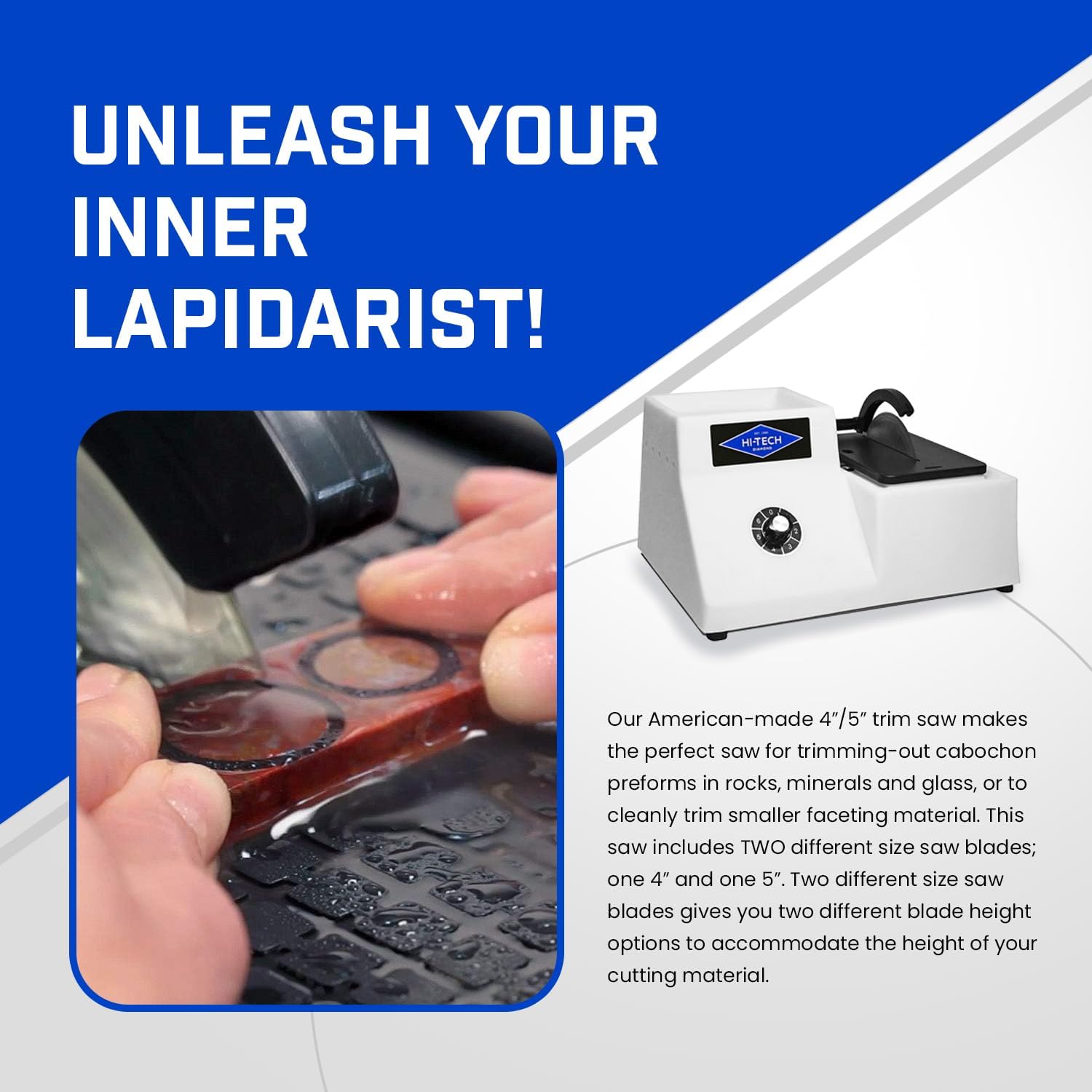
If you’re new to cutting rocks, a trim saw is exactly what it sounds like: a small, precise saw fitted with a thin diamond-edged blade that slices rough stone (uncut rock fresh from the ground or a dealer) into workable pieces. Unlike a slab saw — which is larger and meant to cut thick, full-size slabs — a trim saw is the workhorse you reach for when you need to clean up a piece, remove a bad spot, or cut a preform (a rough outline of your finished cab or gem shape, trimmed close to size before grinding begins). Most hobby and studio lapidaries own at least one. The question that trips people up isn’t whether to get one — it’s which blade diameter to run, what coolant system to use, and when the saw sitting on your bench stops being enough. This guide answers all three, using Hi-Tech Diamond’s lineup as the comparison spine, because their 4″–10″ range covers almost every need a working lapidary faces.
| EDITOR'S PICKHi-Tech Diamond 6" Lapidary Saw… | Mid-tierHi-Tech Diamond 4"/5" Lapidary… | Budget pick[JINGLING 6 inch Diamond Lapidar](https://www.amazon.com/dp/B07ZRJHFRP?tag=greenflower20-20)… | |
|---|---|---|---|
| Blade Size | 6" | 4"/5" | 6" |
| Motor Power | 1/4 HP | — | — |
| Speed | Variable | — | — |
| Blades Included | 2 | — | 5 |
| Vise Included | ✓ | — | — |
| Tool Set | — | ✓ | — |
| Price | $589.00 | $359.00 | $19.99 |
| See on Amazon → | See on Amazon → | See on Amazon → |
Blade Size Is a Capacity Decision, Not Just a Price Decision
The first number on any trim saw — 4″, 6″, 8″, 10″ — is the blade diameter, and it sets a hard ceiling on how thick a piece of rough you can cut in a single pass. A rough rule from the Gem Society’s lapidary equipment guide: usable cutting depth is roughly 35–40% of blade diameter after accounting for blade mounting, arbor clearance, and the blade’s own kerf (the narrow slot the blade cuts through the material). That means:
By the Numbers — Usable Cutting Depth by Blade Size
| Blade Diameter | Approx. Usable Depth | Common Use Case |
|---|---|---|
| 4″ | ~1.3–1.5″ | Thin slabs, small nodules, trim work on preforms |
| 6″ | ~2.0–2.2″ | Mid-size agates, jasper nodules up to softball-size |
| 8″ | ~2.8–3.0″ | Larger rough, fluorite cubes, thunder eggs |
| 10″ | ~3.5–3.8″ | Serious rough, near-slab territory, studio production |
Hi-Tech Diamond publishes these clearance specs on their individual product pages; Kingsley North’s listings cross-reference them with compatible saw models, which is a useful double-check before you buy.
Here’s where practitioners get into trouble: they buy the 4″ because it’s the cheapest entry point (typically $35–$55 for the blade alone at mid-2026 pricing per Kingsley North’s listings), then discover that half their rough won’t fit, and they’re making multiple repositioned cuts — which introduces misalignment and wastes material. If your rough regularly exceeds 1.5″ in the dimension you’re cutting, the 4″ is already the wrong tool regardless of budget.
The 6″ is the honest sweet spot for most intermediate hobbyists. It handles the range of nodules and slabs that show up from Tucson buying or online sourcing, and Hi-Tech Diamond’s 6″ sintered blades (sintered meaning the diamond abrasive is bonded through the full thickness of the blade, not just coated on the surface — which matters for longevity) carry strong owner-reported durability. Across aggregated reviews on lapidary forums and dealer Q&A sections, the pattern is consistent: 6″ sintered blades from Hi-Tech Diamond outlast comparable electroplated options by a significant margin in hard material like agate and jasper.
The 8″ becomes the right answer when you’re regularly cutting material that’s pushing 2.5–3″ thick, or when you’re doing enough volume that a slightly deeper single pass saves meaningful time. The 10″ is a studio or production decision — we’ll address that at the end.
Coolant Systems: Water, Oil, and the Mess-vs.-Performance Tradeoff
Every trim saw needs a coolant. The blade generates heat as it cuts, and heat is the enemy of both the blade’s diamond matrix and the stone itself (thermal shock can crack a piece mid-cut). The coolant also flushes the kerf, carrying away the fine rock dust (called swarf) that would otherwise clog the blade and slow the cut. What you run as coolant — and how the saw delivers it — shapes the entire daily experience of using the machine.
Water-based coolants are the entry-level default. They’re clean, non-toxic, and easy to dispose of per most municipal guidelines. The tradeoff: water rusts unprotected metal parts fast, it can promote bacterial growth in the reservoir if you let it sit, and in dry shop climates it evaporates quickly. Hi-Tech Diamond saws in the 4″–6″ range are typically designed around water-based systems, and owners running these report needing to check reservoir levels frequently during longer sessions.
Oil-based coolants (most often a lightweight mineral oil or a purpose-made lapidary oil, not petroleum cutting oil) provide better lubrication, don’t rust the saw, and tend to extend blade life in hard material. The Lapidary Journal Jewelry Artist’s reference guides on saw setup consistently note that experienced cutters working with hard, abrasive material like flint or chert often prefer oil for this reason. The downsides are real though: oil-saturated swarf is a disposal headache, the smell in an enclosed shop bothers some people, and oil mist on your finished stones means more cleanup before you move to grinding.
What Hi-Tech Diamond’s lineup does differently at the 8″+ tier: The larger saws in the Hi-Tech Diamond range — the 8″ and 10″ models — move to enclosed or semi-enclosed blade guard systems with a recirculating reservoir. This design keeps coolant loss lower, reduces misting (the fine spray that gets on everything in the shop), and lets you run longer sessions without topping off. Published specs from Hi-Tech Diamond’s product documentation describe the 10″ unit’s reservoir as significantly larger than the 6″, which matters in a production context. Owners running the 8″ in club environments note that the recirculating setup makes cleanup substantially faster than the open-tray systems on smaller saws.
Practical decision rule on coolant: If you’re cutting less than an hour per session in a home shop, water-based coolant in a 4″ or 6″ saw is fine — just drain and dry the tray when you’re done. If you’re running multi-hour sessions or working hard silicates consistently, the step up to oil (on a compatible saw) or to the enclosed recirculating system in the 8″–10″ range pays back in blade life and less mid-session maintenance.
The Upgrade Decision: When Your Current Saw Is Holding You Back
This is where the decision framework gets useful. Most practitioners plateau at one of two inflection points:
Inflection Point 1: You’re repositioning cuts more than once per piece. If you’re regularly flipping or repositioning a nodule to make multiple passes because it won’t fit in a single cut, you’re losing accuracy and adding risk. Stone moves between passes, and even a small shift produces an uneven face that then costs you extra time on the grinding wheel. Per the Gem Society’s lapidary equipment guide, properly sized rough should ideally be cut in one or two deliberate passes without repositioning. If you can’t do that with your current blade, the blade size — not your technique — is the limiting factor.
Inflection Point 2: Blade wear is happening faster than expected. If you’re in materials harder than 6.5 Mohs (quartz, agate, jasper, tourmaline rough) and running an entry-level electroplated 4″ blade, you’ll burn through blades fast. The math shifts: Hi-Tech Diamond’s 6″ sintered blades run higher upfront (roughly $60–$90 depending on kerf width and grit, per Kingsley North’s current listings) but owner consensus across aggregated reviews suggests 3–4× the cutting life in hard material compared to budget electroplated options. The Mineralogical Record’s workshop notes on lapidary tool economics echo this pattern — sintered construction is the long-run cost win in abrasive stone.
The 10″ question is genuinely different from the 4″-to-6″ or 6″-to-8″ upgrade. A 10″ Hi-Tech Diamond trim saw moves into near-slab-saw territory in price (mid-2026 street pricing puts complete units above $400 at most dealers, with the blade alone in the $100–$150 range). The legitimate reasons to be there: you’re running a small commercial studio, you’re cutting slabs for a gem club on a shared basis, or you’re processing large rough (think big fluorite, large thunder eggs, or raw material from mine-run purchases at Tucson). If you’re an individual hobbyist cutting once or twice a week, the 8″ is almost certainly the ceiling you need.
The Clear “If X, Then Y” Decision Rule
Work through these in order:
-
If your rough is consistently under 1.5″ in the cut dimension and you’re a true beginner → Start with the 4″. It’s the right entry point and the budget is forgiving.
-
If you’re past your first year and working agates, jaspers, or any nodules bigger than a golf ball → The 6″ sintered Hi-Tech Diamond blade is your answer. Buy the sintered version, not electroplated.
-
If you’re doing multi-hour sessions, working consistently in hard silicates (7+ Mohs), or cutting for a club or small studio → Move to the 8″. The enclosed coolant system alone justifies the step up in a working-shop context.
-
If you’re repositioning cuts on more than 30% of your pieces → You’ve outgrown your blade size. Upgrade before you buy more rough.
-
If the 10″ is on your radar → First ask whether a slab saw wouldn’t serve you better. At that price and capacity point, you’re in slab-saw territory for many applications, and a dedicated slab saw gives you a proper vise feed and consistent slab thickness. The 10″ trim saw is a production trim tool, not a slab replacement — keep the use cases distinct.
One final note on coolant compatibility: before upgrading blades or saws, verify that your saw’s existing tray and pump are rated for the coolant type you intend to run. Some smaller Hi-Tech Diamond models specify water-based coolant only, and running oil in a water-rated reservoir can damage seals over time. Hi-Tech Diamond’s published product documentation lists coolant compatibility by model — check it before you pour anything new in.
The right trim saw doesn’t make you a better cutter. But the wrong one, or a blade you’ve outgrown, absolutely slows you down.