April 26, 2026 • Petra Andersen • 8 min reading time • Prices verified June 25, 2026
Grit Kits Ranked by Value Per Pound: What the Stage Timing Numbers Tell You Before You Buy
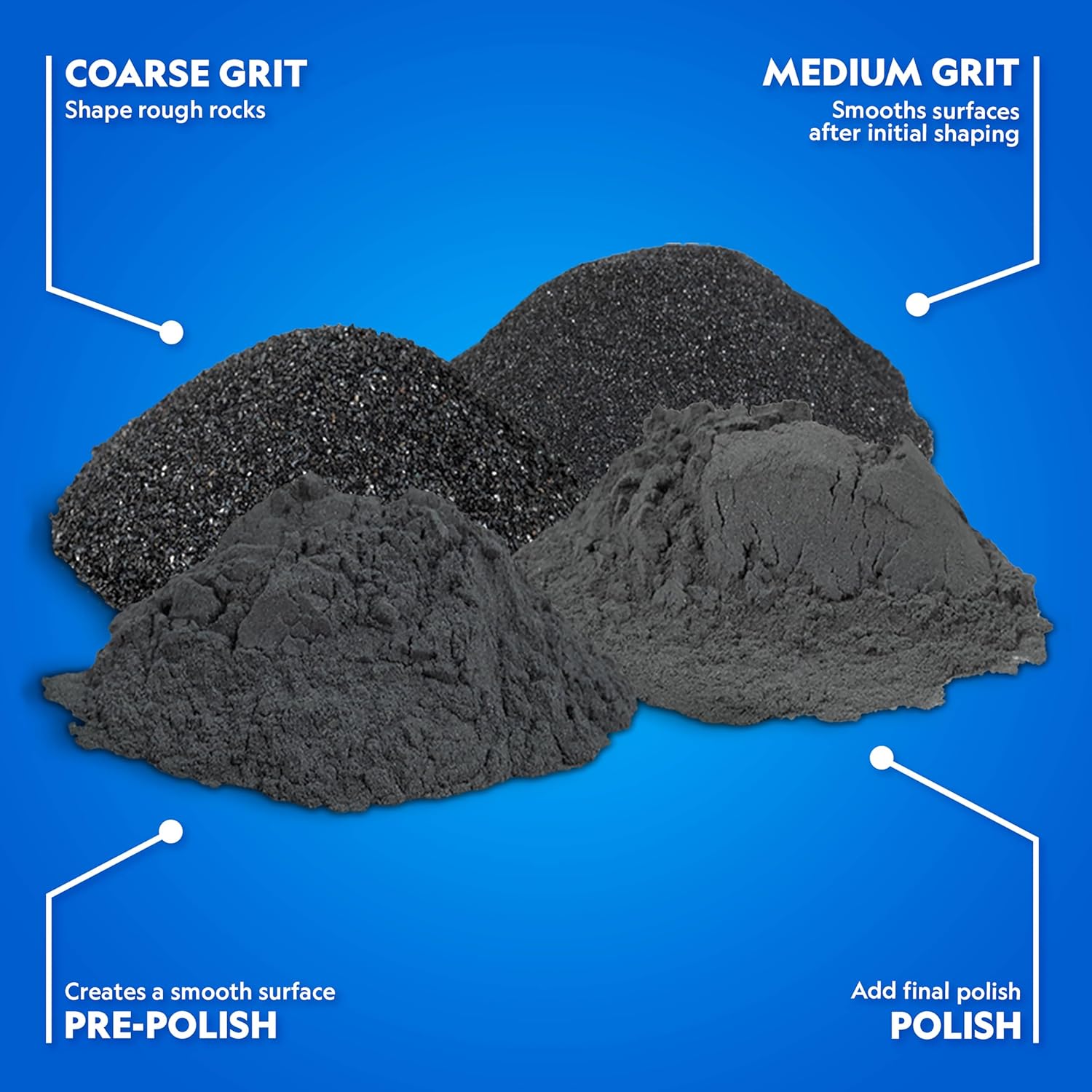
If you’ve just started tumbling rocks — or you’re a few batches in and wondering why your stones still look scratchy — this article is worth a few minutes. A rock tumbler works by cycling stones through a sequence of abrasive powders called grit (think of it like sandpaper, but in powder form and used wet inside a rotating barrel). You move from coarse grit that shapes the stone, through progressively finer grits that smooth the surface, and finally to a polish compound that brings out the shine. The grit and polish powders are usually sold together as a grit kit — a bundle designed to carry a batch of stones from rough to finished. Most starter kits cost between $10 and $30 and promise to cover several batches. What the packaging rarely tells you is how long each stage should run, and that number — measured in days, not minutes — is the variable that determines what a kit actually costs you in the long run.
This guide ranks the most widely available grit kits by value per pound of abrasive, factors in the stage timing each kit recommends, and gives you a clear decision rule at the end based on your barrel size and stone hardness.
| EDITOR'S PICK[Polly Plastics Rock Tumbler Gri…](https://www.amazon.com/dp/B075MZ36FF?tag=greenflower20-20) | Mid-tier[KomeStone Rock Tumbler Grit Kit…](https://www.amazon.com/dp/B0B74KYP44?tag=greenflower20-20) | Budget pick[NATIONAL GEOGRAPHIC Rock Tumble…](https://www.amazon.com/dp/B01MRKI4W0?tag=greenflower20-20) | |
|---|---|---|---|
| Total weight | — | 4LB | — |
| Rock capacity | — | 25 lbs | 20 lbs |
| Ceramic media incl. | ✓ | ✓ | — |
| Number of steps | — | 4-Step | — |
| Price | $35.49 | $28.98 | $18.99 |
| See on Amazon → | See on Amazon → | See on Amazon → |
Why Stage Timing Changes Everything About Kit Value
Here is the core insight that most kit comparisons miss: a grit kit isn’t just a weight of powder. It’s a consumption schedule. If a kit’s instruction sheet tells you to run coarse grit for 7 days rather than the standard 4–5, you will burn through coarse grit roughly 40–75% faster per batch — depending on your barrel load and stone-to-water ratio. Run ten batches a year and that difference compounds into a meaningful annual cost gap.
The International Gem Society’s rock tumbling grit guide notes that recommended stage times vary significantly by stone hardness. For quartz-family stones (agate, jasper, petrified wood — all registering 7 on the Mohs hardness scale), a standard rotary tumbler cycle looks roughly like this:
Standard 4-Stage Rotary Cycle — Quartz-Family Stones
| Stage | Grit | Recommended Duration |
|---|---|---|
| Coarse shaping | 60/90 silicon carbide | 4–7 days |
| Medium smoothing | 150/220 silicon carbide | 4–5 days |
| Pre-polish | 500F silicon carbide or aluminum oxide | 3–4 days |
| Polish | Cerium oxide or aluminum oxide | 3–5 days |
Softer stones (obsidian, calcite, fluorite — Mohs 3–5) can move through stages faster; harder or more angular rough may extend coarse stage significantly. The Lapidary Journal has consistently published guidance that coarse stage is where most hobbyists under-time — rushing past it produces stones that look fine until the polish stage reveals subsurface scratches that no amount of cerium oxide will fix.
The practical takeaway: a kit that sells you more coarse grit relative to polish is better calibrated for real-world use, where coarse is always the limiting reagent.
The Kits Worth Comparing in 2026
Prices below reflect Kingsley North and major online retailer listings as of May 2026. The market for lapidary grit has been stable since mid-2025 after silicon carbide pricing settled following supply disruptions in 2023–2024.
National Geographic Starter Grit Kit (included with branded tumblers)
The kit bundled with the National Geographic tumbler — one of the best-selling entry-level units in the hobby — ships with four grit stages plus a plastic polish bag. Per the included instruction guide, the coarse stage is rated for a 3-pound barrel load and the manufacturer suggests 7–10 days for harder stones. The coarse grit packet weighs approximately 3.5 oz, which means at the recommended 2 tablespoons per pound of rock, a single batch consumes the entire coarse allotment.
Value verdict: This kit is priced right for a single trial batch. It’s not a repeating-use value — it’s an orientation. Owners on gem club forums routinely note they exhaust the coarse supply in one run and then source replacement grit separately. Treat it as a sampler, not a supply.
Kingsley North 4-Stage Silicon Carbide Kit (3 lb and 10 lb options)
Kingsley North’s house-brand grit kits are among the most cited options in club discussions and lapidary instructor recommendations. The 3-pound variety ships with approximately:
- 1 lb coarse (60/90)
- 1 lb medium (150/220)
- 0.5 lb pre-polish (500F)
- 0.5 lb polish (aluminum oxide or cerium oxide depending on version)
At Kingsley North’s listed price of approximately $18–$22 for the 3-pound kit (May 2026 pricing), the cost per pound of combined abrasive works out to roughly $6–$7.30/lb. The 10-pound version — which scales the same ratio — drops to approximately $4.50–$5.00/lb. That’s a meaningful gap for anyone running a Lortone 3A or similar 3-pound barrel on a weekly cycle.
The stage timing recommended by Kingsley North aligns with Lortone’s own published tumbler manuals: 5–7 days coarse, 4–5 days medium, 3–4 days pre-polish, 3–5 days polish. Importantly, the coarse allotment in this kit (1 full pound per 3 pounds of grit total) reflects a realistic supply-to-demand ratio for quartz-family stones.
Value verdict: The 10-lb kit is our recommended entry point for anyone running monthly batches. The cost-per-pound math favors bulk, and the stage ratio is calibrated for practical use rather than marketing optics.
Lortone OEM Grit Kits (sold with and separately from Lortone tumblers)
Lortone’s own-brand grit kits are sized for their barrel lineup and carry manufacturer-matched timing recommendations in the included instruction sheets. Lortone’s documentation specifies stage durations by stone type more granularly than most competitors — distinguishing between soft, medium, and hard material — which is useful for intermediate tumblers moving beyond all-quartz loads.
Price per pound runs slightly higher than Kingsley North at approximately $7–$8/lb for the standard kit, reflecting the brand premium and the tighter sizing to specific barrel loads. Owners who run Lortone machines consistently report that the OEM kit timing guidance reduces the guesswork that leads to subsurface scratch problems, which partially justifies the premium for newer hobbyists who haven’t developed intuitive stage-reading skills yet.
Value verdict: Worth the premium if you’re on a Lortone machine and haven’t internalized stage timing by feel. Once you’re confident reading your stones at each stage, the lower cost-per-pound of a bulk silicon carbide purchase from a bulk supplier makes more financial sense.
Bulk Silicon Carbide Purchased Separately (Advanced Option)
For anyone running a Lortone 33B or larger commercial barrel — or any studio or club context where multiple barrels run simultaneously — the cost math tilts decisively toward purchasing silicon carbide grit in bulk (5–50 lb bags) and polish compounds separately. The Lapidary Journal has noted in equipment-focused issues that production-level use essentially makes pre-packaged kits uneconomical above about 12 batches per year.
Bulk 60/90 silicon carbide sourced from lapidary supply wholesalers runs approximately $2.50–$3.50/lb at the 25-lb quantity level as of May 2026. Cerium oxide polish, which is weight-for-weight more expensive but used in smaller quantities, runs $18–$30/lb depending on grade and supplier — but per-batch consumption is low enough that the per-batch cost is manageable.
Value verdict: If you’re running more than one barrel or doing 12+ batches per year, do the per-pound math on bulk purchases. The kit format is paying for convenience and packaging, not abrasive quality.
What the Stage Timing Numbers Actually Tell You Before You Buy
Here’s how to use a kit’s recommended stage schedule as a purchase filter before you add anything to your cart:
Step 1: Check the coarse grit weight as a percentage of the total kit weight. A well-balanced kit should allocate 30–40% of total abrasive weight to coarse grit. Kits that skew below 25% coarse are implicitly assuming shorter coarse stages — which works for softer stones but will leave intermediate tumblers frustrated when running jasper or agate.
Step 2: Calculate cost per pound of usable abrasive. Divide the total kit price by the total abrasive weight (excluding the polish, which is priced differently by volume). A kit at $20 for 2.5 lbs of silicon carbide is $8/lb — compare that against bulk pricing before committing.
Step 3: Match the kit’s rated barrel load to your actual barrel. A kit calibrated for a 3-pound barrel run in a 6-pound barrel will produce inconsistent coverage. Lortone’s manuals specify load ratios explicitly; the International Gem Society’s grit guide also covers the stone-to-water-to-grit ratio math in accessible terms.
Step 4: Read the stage timing on the label or instruction sheet. If the kit recommends fewer than 4 days for coarse on quartz-family stones, that’s a signal the kit is optimized for demo conditions or soft stones — not production use on agate or jasper.
The Decision Rule
If you’re running 1–4 batches per year on a starter tumbler with mixed soft stone material: A pre-packaged kit in the $15–$22 range from a reputable lapidary supplier (Kingsley North or equivalent) gives you calibrated ratios without the commitment of bulk purchasing. The 3-lb Kingsley North kit at roughly $6–$7/lb is the strongest value in this tier.
If you’re running 5–12 batches per year on a Lortone 3A or equivalent, primarily with quartz-family stone: Step up to the 10-lb Kingsley North kit or equivalent bulk pack. The per-pound cost drops by 30–40% and the coarse supply stops being the bottleneck it is in single-kit purchasing.
If you’re running multiple barrels, teaching a club, or operating a small production studio: The pre-packaged kit format is no longer the right unit of purchase. Buy silicon carbide in 25-lb bags, cerium oxide or aluminum oxide polish by the pound, and manage your stage timing from Lortone’s published manuals or the Lapidary Journal’s documented stage schedules. You’ll spend roughly half as much per batch and gain full control over your grit ratios.
The numbers aren’t complicated once you look at them in sequence. Stage timing is the multiplier — and the kit’s coarse-to-total ratio is the tell.